
Slot Machine Design and What It Does to the Player
Near misses, sub-stake payouts celebrated as wins, turbo spins and autoplay all pull the same lever: how many times an hour you pay the house edge. The arithmetic behind the animation.
Published: December 23, 2025 • By Harriet Lowell
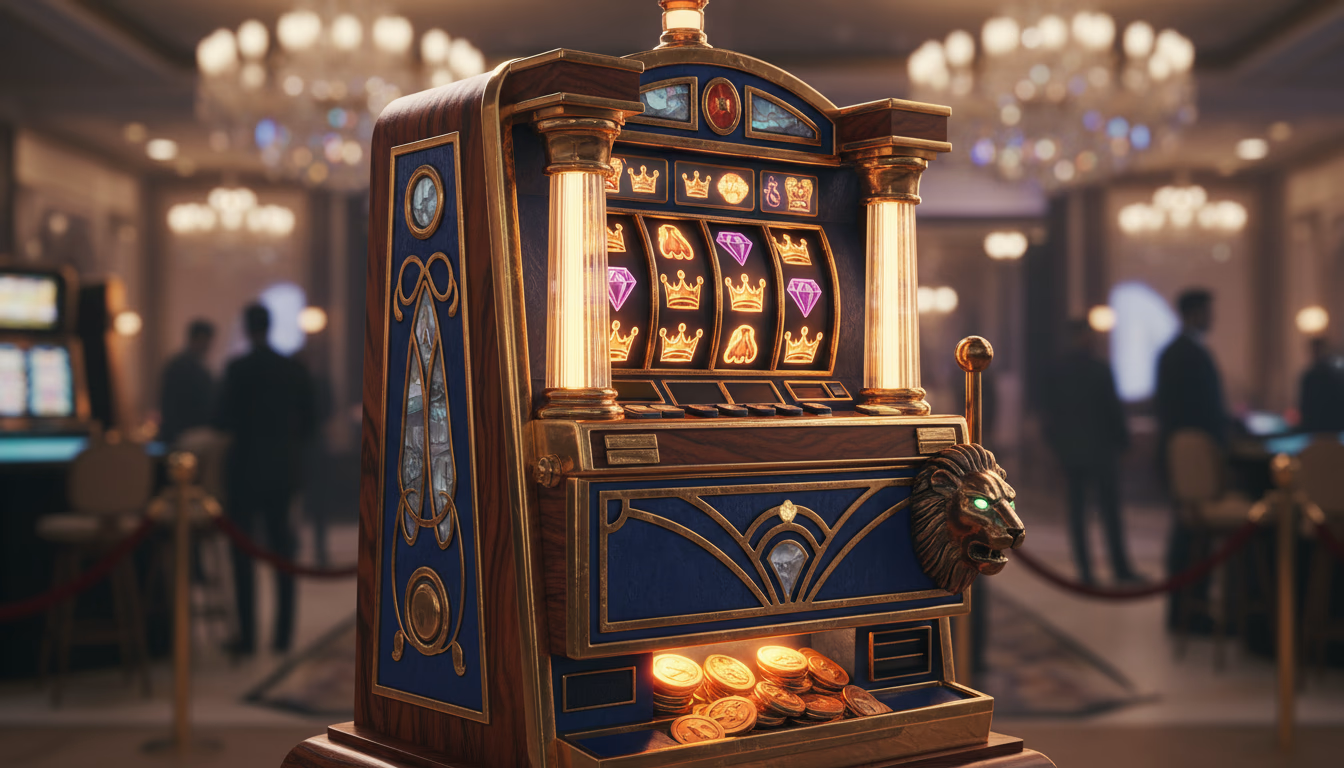
A slot is a priced product, and the price is published: one hundred per cent minus the game's return to player, charged on every unit that crosses the machine. What the design decides is not that price but how often you pay it — how many rounds pass through your hands in an hour, and how much is staked in each one. Nearly every feature below works on that second number, which is why a player can know a game's RTP by heart and still misjudge what an evening costs.
The arithmetic before the psychology
Take a 96 % game and a stake of 1 CAD. The house keeps four per cent of everything wagered. At 600 spins an hour — ten a minute, which any turbo button beats — 600 CAD passes across the machine, and four per cent of 600 is 24 CAD. That is the expected cost of the hour. Move to a 94 % version and the same hour costs six per cent of 600, or 36 CAD — half as much again, for two percentage points written in small type on an information screen.
Speed multiplies the house edge in exactly the way stake size does. Doubling the stake from 1 to 2 CAD doubles the hourly cost; doubling the pace from 300 spins to 600 does the same. A player who feels careful betting twenty cents, then runs autoplay on a fast game for three hours, hands over more than one who stakes 2 CAD and spins slowly for twenty minutes. A studio cannot change the return of a certified game while you play, but it can compete on how many rounds per hour a player will sit through — and it does.
| Stake per spin | Spins per hour | RTP | Expected cost of the hour |
|---|---|---|---|
| 1 CAD | 600 | 96 % | 24 CAD |
| 1 CAD | 600 | 94 % | 36 CAD |
| 1 CAD | 300 | 96 % | 12 CAD |
| 2 CAD | 600 | 96 % | 48 CAD |
| 0.20 CAD | 900 | 96 % | 7.20 CAD |
These are long-run averages: the experience of a slot lives in the gap between the average and the hour you actually had, and design works in that gap.
Near miss
A near miss is a losing outcome dressed as a narrowly failed win: two jackpot symbols on the first reels and the third stopping just above the payline, or a scatter count one short of the feature. Mechanically it is a loss like any other: the outcome is settled by the random number generator when the button is pressed, and the reels merely animate a result that already exists. What makes it worth building is that it does not feel like an ordinary loss: it reads as progress, and the natural response to an interrupted sequence is to finish it. You need not believe anything false about probability for this to work; it operates below belief, on timing and attention. The older idea underneath it — that a machine can be warming up, that a result can be due — is examined in the piece on older gambling superstitions.
Losses disguised as wins
The second mechanism is arithmetic rather than psychology. On a multi-line slot the stake is spread across many lines at once, so a round can return something and still return less than it took: put in 1 CAD, get 40 cents back, and you are down 60 cents. The machine has a choice about how to present that, and it can count the 40 cents into the balance with a coin sound, a flashing win line and the same short celebration it uses for a genuine win.
The industry term is a loss disguised as a win, and it matters because it corrupts the feedback a player uses to judge a session: someone counting outcomes by how they were celebrated rather than by how they moved the balance can leave a machine believing the evening was roughly even. The defence takes no willpower — ignore the animation and read the number. Any round where the balance is lower after the celebration than before it was a losing round, whatever the sound said.
Speed, autoplay and the default stake
Three settings decide how often you pay the edge, and two are pre-set before you arrive. The first is round duration: a base spin resolving in six seconds gives roughly 600 rounds an hour, and quick-spin modes cut the animation to push that higher. The second is autoplay, less a speed feature than a decision feature: it removes the pause between rounds, so the choice to keep playing is made once and executed two hundred times. The third is the default stake — a game opening at 1 CAD rather than 0.20 CAD quintuples the hourly cost for anyone who never touches the stake control.
A live table is the contrast. There the edge is fixed by the rules, the tempo is set by a human, and rounds per hour are an order of magnitude lower — which changes the cost of an evening more than any table-side tactic, including those surveyed in this look at live dealer play.
Volatility is not RTP
The two words get used interchangeably in marketing copy, and they measure different things. RTP is the share of wagered money returned over a very long run — the price. Volatility describes how that return is distributed: frequent small amounts, or rare large ones. Two games can return 96 % each and feel nothing alike. A high-volatility game pays nothing in most rounds and occasionally pays a great deal, so the same bankroll buys fewer hours even though the hourly expectation is identical; a low-volatility game returns something often, and many of those returns are the sub-stake payouts described above. A description praising a game as high-volatility without naming an RTP has given the shape and withheld the price.
The buy-bonus button
A feature-buy button pays a fixed multiple of the stake to enter the bonus round at once. The multiple is printed on the button, so the price of a click is never a mystery — the turnover it creates usually is. If the button reads 100×, one click stakes what a hundred base spins would. Twenty clicks at 100 CAD put 2 000 CAD across the machine: four per cent of that is 80 CAD of expected cost, reached in minutes rather than three hours. The button does not raise the house edge, it raises the rate at which turnover is generated, which does the same work on a bankroll. One detail is worth checking first — some titles publish a different RTP for bought features than for base play.
The number on the info screen is the only one that counts
Many slot titles exist in more than one certified configuration — same artwork and features, released at several return levels, with the operator choosing which build to run. The gap between top and bottom build can be several percentage points, which on the arithmetic above separates a 24 CAD hour from a 36 CAD one. A figure quoted in a review or in a list of «the best RTP slots» therefore describes some version of the game, not necessarily the one in your browser. The only number that applies to your session is the one printed in the game's own information screen, opened after it loads and before the first spin.
Where bonuses fit
Bonus terms rarely change the price of a spin, but they change how many spins you are required to take — the same lever every feature above pulls. A wagering requirement is an instruction to generate turnover. Erabet publishes a welcome offer of 100 % up to 500 CAD with 100 free spins, carrying 35× wagering on the bonus and on free-spin winnings inside 14 days — the operator's own wording, read on 23 September 2026. Applied to a 100 CAD bonus, 35× means 3 500 CAD of required turnover; on a 96 % game that costs four per cent of 3 500, or 140 CAD, and at 1 CAD a spin it is 3 500 spins, close to six hours at the pace above. That calculation, rather than the headline percentage, is the frame to carry into the breakdown of Erabet's bonus terms.
What is left to do about it
Four habits cover most of the ground: read the RTP on the information screen of the build actually loaded, set the stake instead of accepting the one the game opens with, leave turbo and autoplay off so the pause between rounds survives, and judge each round by the balance rather than the animation. None of this makes a slot a good bet — the price is charged on every unit either way. It removes the parts of the experience that quietly raise the number of units. A player who knows that an hour of 1 CAD spins on a 96 % game costs about 24 CAD, and who has taken the speed controls back, is buying something they have priced — a different activity from the one the default settings produce.
About the author
Harriet Lowell worked with product data before she started writing about gambling, which is why her pieces tend to end in a number rather than an adjective. She covers slot mechanics, live table rules and the way game design shapes how long a session lasts. Her rule on this site is simple: if a figure cannot be checked by the reader, it does not go on the page.