
What Actually Changes the Result at a Live Dealer Table
Payout schedules, wheel type and rounds per hour set the price of a live table. Streaks, result boards and progression systems do not. The arithmetic, line by line.
Published: March 19, 2026 • By Harriet Lowell
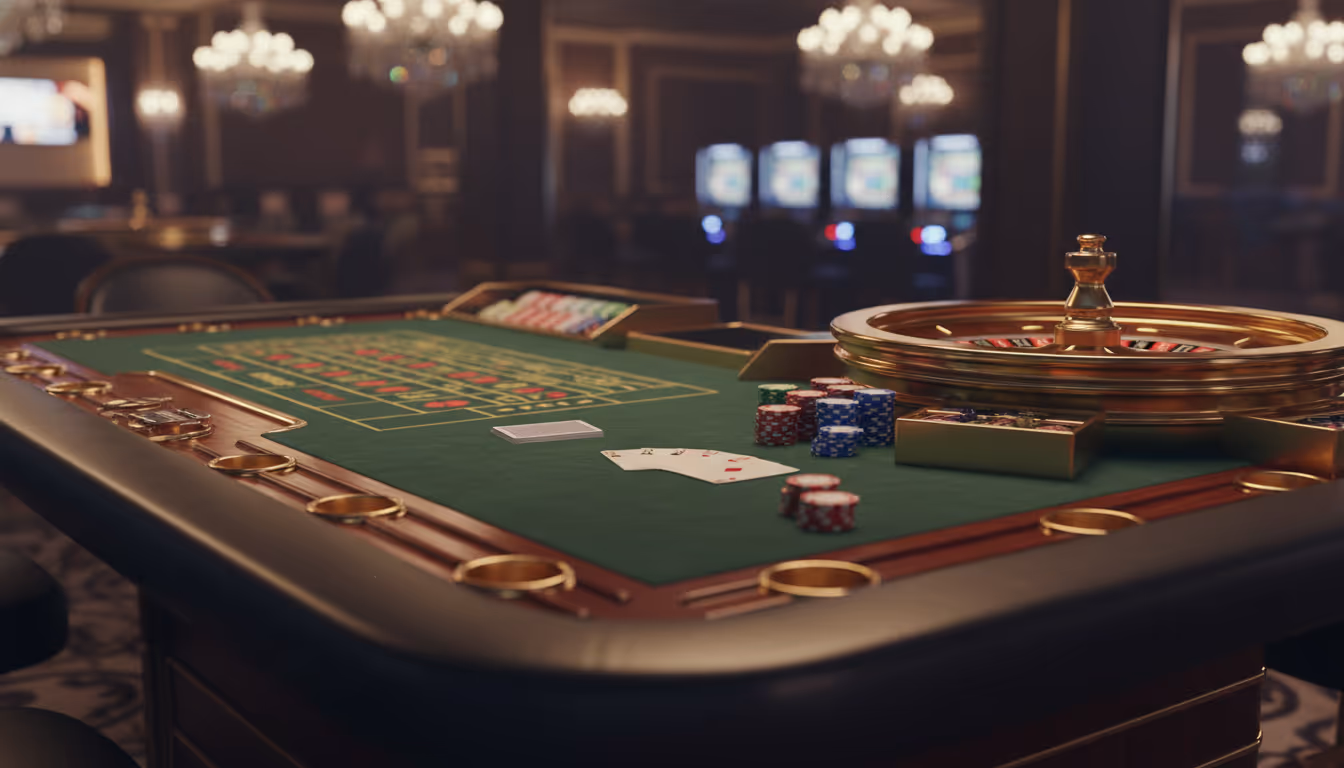
At a live table the arithmetic is settled before the first card leaves the shoe. The payout schedule, the rules printed next to it and the number of decisions per hour determine what an evening costs. The dealer, the run of results on the board and the system in a player’s head do not appear anywhere in that calculation.
Sorting the two groups is the entire exercise. What follows separates the levers that measurably change the price of an hour from the habits that only feel as though they do.
The cost of an hour has three inputs
Expected cost = rounds per hour × average stake × house edge. Nothing else enters it. A blackjack table dealing about 60 hands an hour at 10 CAD a hand puts 600 CAD of turnover through in that hour; at a basic-strategy edge of roughly 0.5 per cent, the expected cost is 3 CAD.
Those three inputs are also the three things a player can change. Two of them — the rules and the stake — are chosen before sitting down. The third, pace, is mostly chosen by the format.
The payout schedule is the biggest single decision
Blackjack paying 3:2 on a natural and blackjack paying 6:5 look identical at the table and are not the same game. The reduced payout adds roughly 1.4 percentage points to the house edge, taking a 0.5 per cent game to about 1.9 per cent.
On the same 600 CAD of hourly turnover: 3 CAD an hour at 3:2, 11.40 CAD an hour at 6:5. Nearly four times the price for the same seat, the same stake and the same decisions. Across ten hours of play that is 30 CAD against 114 CAD.
The other rule lines matter too — whether the dealer stands or draws on soft 17, whether doubling after a split is allowed, whether surrender exists — but each is worth a fraction of a percentage point, and together they usually add up to less than the single 3:2 versus 6:5 difference. If only one line on the table placard gets read, it should be that one.
Roulette: one extra pocket, double the price
A single-zero wheel returns 2.70 per cent of every stake to the house. A double-zero wheel returns 5.26 per cent. The game plays identically; the price is not close.
Take a live table completing about 35 spins an hour at 10 CAD a spin — 350 CAD of turnover. European: 9.45 CAD an hour. American: 18.41 CAD an hour. Moving between the two wheels is the cheapest improvement available at any table in the building, and it requires no skill, no system and no change in how anyone plays.
Where a single-zero table offers la partage or en prison, half the stake is returned (or held) on even-money bets when zero lands, which halves the edge on those bets to about 1.35 per cent. The same 350 CAD of even-money play then costs about 4.73 CAD an hour — roughly a quarter of the American figure. It is also worth knowing that on a single-zero wheel every bet carries the same 2.70 per cent: splitting stakes across inside numbers instead of outside chances changes the shape of the session, not its price.
Side bets are the expensive part of a cheap table
Side bets exist because they are priced well above the main game. A player sitting at a 0.5 per cent blackjack table with 10 CAD in the box and 5 CAD on a side bet whose edge is, say, 5 per cent, is paying 0.05 CAD of expected cost on the main hand and 0.25 CAD on the side bet: five times the cost on half the money. The exact figure varies by paytable and deck count, and that is the practical rule — if a side bet does not publish its paytable, its price cannot be calculated, and an unpriceable bet should be assumed to be an expensive one.
Pace multiplies everything else
Rounds per hour sits in the formula as a plain multiplier, so format matters more than most rule details. A live table shared with other players deals slowly: the dealer waits for decisions, settles bets and shuffles. A solo software table deals as fast as the button can be pressed. Running 200 hands an hour instead of 60 at the same stake and the same edge triples the hourly cost without a single rule changing.
That is the genuine, unglamorous advantage of the live format: it is structurally slower, and slower is cheaper per hour. It cuts the other way for anyone who plays several tables at once. The relationship between speed, rhythm and how long a session runs is exactly what game interfaces are built around, a point covered in the design of slot machines, and the live studio format borrows a good deal of it.
Stake against bankroll: the part actually under control
Expected cost is small and swings are not, and confusing the two is how sessions end early. An even-money roulette bet has a standard deviation of about one unit per spin, so 35 spins carry a spread of roughly 5.9 units — about 59 CAD at 10 CAD stakes — against an expected loss of 9.45 CAD. Over one evening the swing dominates the edge completely. Over hundreds of hours the edge dominates the swing completely. Both statements are true at once, and stake sizing is what stands between them: a stake small enough that an ordinary run of bad results does not end the evening is the only bankroll rule that survives contact with the arithmetic. More on session structure sits under practical play notes.
What does not change the result
Result boards and streaks. Roulette displays and baccarat road maps record what has already happened. The wheel has no memory, and a shoe that has been shuffled carries none forward either. Reading a board costs nothing in itself; acting on it usually means larger bets at the same edge, which is a real cost.
Progression systems. Doubling after a loss rearranges when money is lost, not how much. Start at 10 CAD on a single-zero wheel: seven consecutive losses on an even-money bet occur with probability (19/37) to the seventh power, about 0.0094 — roughly once in 106 sequences. Recovering that original 10 CAD then requires a 1,280 CAD bet on top of the 1,270 CAD already staked, and the table maximum or the bankroll arrives first. The expected cost stays exactly turnover multiplied by edge, whatever order the stakes come in.
Table feel, dealer choice and timing. None of them are in the formula. A dealer with a good run behind them changes nothing about the next shoe.
Counting a live-streamed shoe. Live blackjack is typically dealt from eight decks and shuffled well before the end of the shoe, which removes the deck-composition swing that counting depends on.
Before sitting down
The checklist is short: find the payout schedule and the rule lines, count the rounds per hour rather than guessing, multiply the three inputs to get the hourly price, skip any side bet whose paytable is not published, and set the stake against the bankroll rather than against the table minimum.
Two things are worth adding where Erabet is concerned, both from what the site itself shows. As read on 23 September 2026 there is no game lobby — the pages carry images and a registration button, so table rules, payout schedules and limits cannot be checked before an account exists, which inverts the order this article recommends. And the operator’s published withdrawal limit of 4,000 CAD a week governs how quickly a good run at the tables can actually leave the account, regardless of how the tables themselves are priced. Bonus money changes the picture again, since table play is normally weighted at a fraction of slot play or excluded outright — that arithmetic is set out in how casino bonuses are priced.
None of this is a strategy for winning. Live tables are priced in the same currency as everything else on a casino site: rounds, stakes and edge. Choosing the 3:2 table over the 6:5 one, the single-zero wheel over the double-zero one and a stake the bankroll can absorb is not a system — it is simply refusing to pay four times more for the same hour.
About the author
Harriet Lowell worked with product data before she started writing about gambling, which is why her pieces tend to end in a number rather than an adjective. She covers slot mechanics, live table rules and the way game design shapes how long a session lasts. Her rule on this site is simple: if a figure cannot be checked by the reader, it does not go on the page.